5 min read · Awakened Skin + Body · North Miami Beach
Every injectable on the market works by putting something into your body. Botox introduces a neurotoxin that temporarily relaxes muscle. Hyaluronic acid fillers add volume from a syringe. Sculptra and Radiesse inject microparticles designed to provoke your body into making collagen around them. All of them can work, none of them are without tradeoffs, and every one of them requires a needle.
Plasma is fundamentally different, not just in how it feels but in what it does: it cues the skin to do what it already knows how to do, rather than relaxing muscle or adding material.
Botox relaxes the muscle so lines cannot form. Fillers physically push the skin outward. Biostimulators like Sculptra deposit poly-L-lactic acid particles that provoke a healing response to a foreign material, and collagen forms around that response. The collagen is real; the trigger is manufactured. And like all injectables, the effect is temporary. The substance is metabolized, the result fades, and the calendar refills, typically every six to eighteen months.
To be clear: nothing here says injectables are bad. They work for many people. The point is that they are not the only option, and most people never hear that an alternative exists that asks nothing to be placed inside the body.
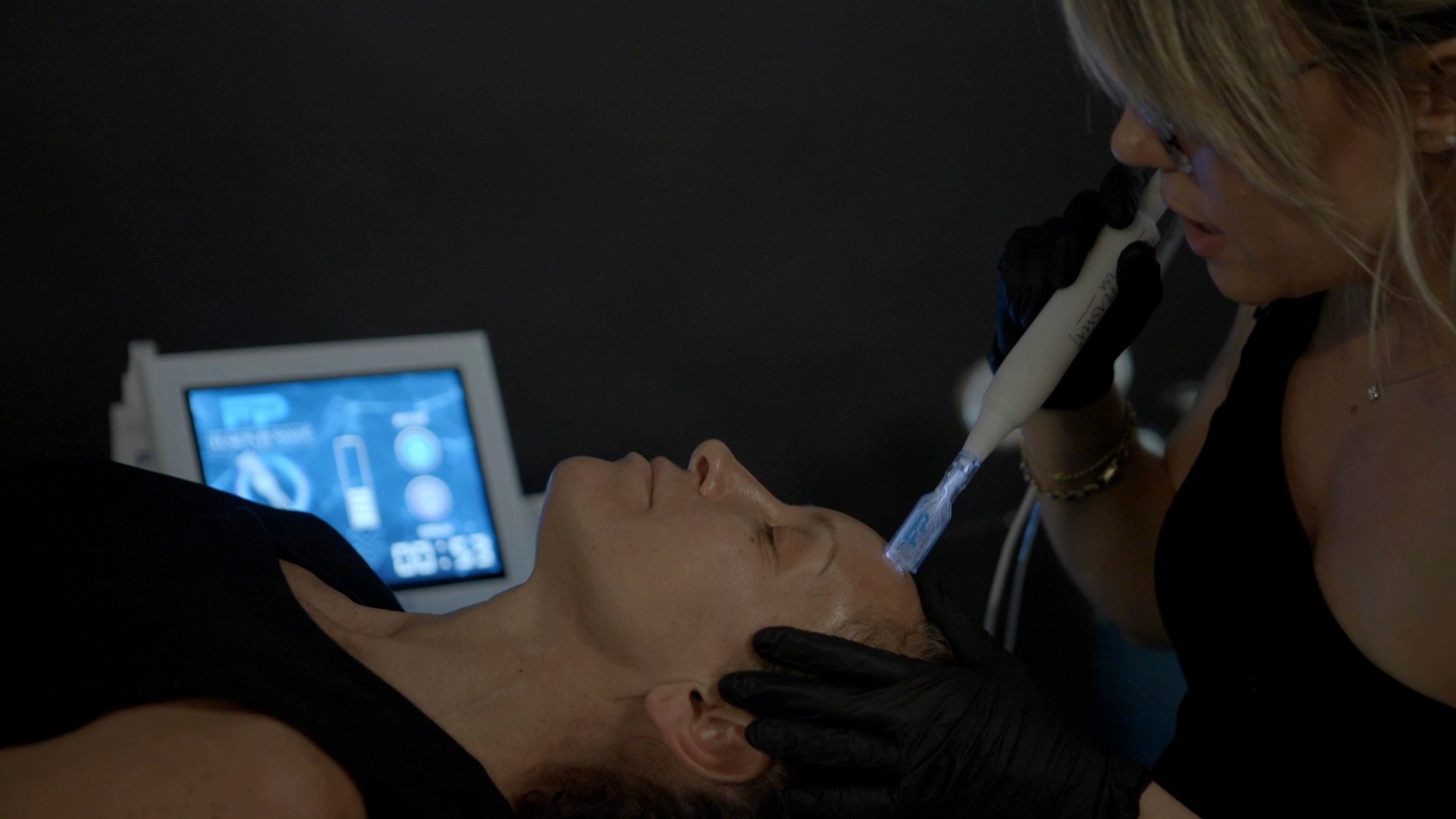
Plasma is ionized gas. Applied to the skin at cold, warm, or hot temperatures, it signals your cells directly. Nothing enters the body.
Cold plasma supports the skin cells' own energy production, so they more efficiently make the collagen, elastin, and hyaluronic acid they are already designed to make. Warm plasma adds gentle resurfacing and tightening across a broad, even field. Hot plasma, our Fibroblast service, creates precise, controlled micro-points that send collagen production into overdrive: the skin contracts immediately and keeps remodeling for up to 90 days, producing in one session the kind of lift clients otherwise plan surgery for.
Sculptra markets itself as a collagen stimulator, and technically it is. The stimulation happens because the body is reacting to a foreign material, and as the particles are metabolized the effect diminishes, which is why maintenance injections are part of the plan.
Plasma stimulates collagen too, with one difference that matters: your own cells do the work in response to a signal, not a substance. There is nothing to metabolize and nothing to top up. The distinction is signal versus injury, renewal versus reaction.
For many people the needle itself is the barrier. Not the price, not the downtime, just the idea of injecting something into their face repeatedly, indefinitely. For others it is the arithmetic of accumulation: Botox every three months, filler every nine to twelve, a biostimulator every couple of years, each resetting to zero as it fades. Plasma compounds the other way. A membership of monthly sessions builds results that stack rather than reset.
Many of our clients come specifically to reduce their injectable routine. They rarely stop overnight; after a series of Fusion Plasma sessions, they find they need less. The skin improves from the inside out instead of being adjusted from the outside in.
Plasma and injectables are not mutually exclusive, and some clients keep both. But if you have been on the injectable schedule for years and find yourself wondering whether there is another way, there is. No needles, no foreign material. Ionized gas, and your skin's own biology.
We will map what plasma can take over, what it cannot, and the order to do it in.